
Phil Edelstein, Woburn MA, August 2025
Table of Contents
Preface
Of the moment, this is a collection of sketches for consideration for Eclipse 2025 August and other projects. Ramains to be determined what will be physical versus virtual objects, web crawler, video, audio.
We have as of June 6 a starting point for a floor plan building upon Eclipse 2024 July sketches and layout.

What is becoming more evident is the nature of collage, montage, juxtaposition across time based media: sonic, visual, sculptural.
I have this recurring remembrance of the role of the Stage Manager from Our Town in the collection here.
This extends the material from more general Tom Ditto focused material framework for Sound Visions – Eclipse 2025. This offered as a sketchbook of some of the ideas I am considering as time and space allow.

There is a parallel meander under cover of Materials for New Works. Between this and several other projects, there is a personal need to for me to collect thoughts and ideas in this crude fashion.

In recent months, there is another collection of personal views with a focus on computer based points of inflection, reflection and departure with other supporting folio of references.
I take this as an opportunity to revisit and find new context from prior works and places using available contemporary means and new intersections.
One remembrance – this montage from Jasper Niblock from a performance a Snug Harbor in the 1980’s with he, Phill Niblock and I surfaced in another passing.

One of the evolving opportunities and vehicle is covered in sketches using a software based collage and montage generator using 3d rotations that results in deep abstraction away from the original source material. The link shows examples of sketches and studies with video clips generated from this evolving Max Jitter patch using various sources as examples. This has surfaced as a viable means of collaboratively integrating visual and sonic materials as a matter of convenience to bring forward here. See earlier collage-montage section below with earlier 2d example that are somewhat less abstract.
Likely that this will also rapidly evolve into interactive live camera component over the course of the evolving material to be shown at Eclipse.
Sketches of New Follies and Ephemera

I have a variety of new components that are being networked together in various technical ways. Just some quick snapshots here as placekeepers. Of long interest has been developing a pallete of techniques to combine light, sound, moving image, sculptural kinetic objects.
I have a growing collection of chimeras and oddities to draw upon. For instance, I am finally getting some traction of pan-tilt platforms for cameras. There are two variations: 1 using Dynamixel servos and the other using DMX moving head fixtures.

The DMX moving head fixtures have surprisingly good fine control of position as cheaper than the robotic servo motors if not the torque.
The orange horn is from John Driscoll.
One sketch is the idea of wrapping LED strips to become elements of 3d objects rather than their native linear form. Varieties not yet shown in these sketchs is the motion of the light and the mechanical motion in counterpoint and gestures that move between media.

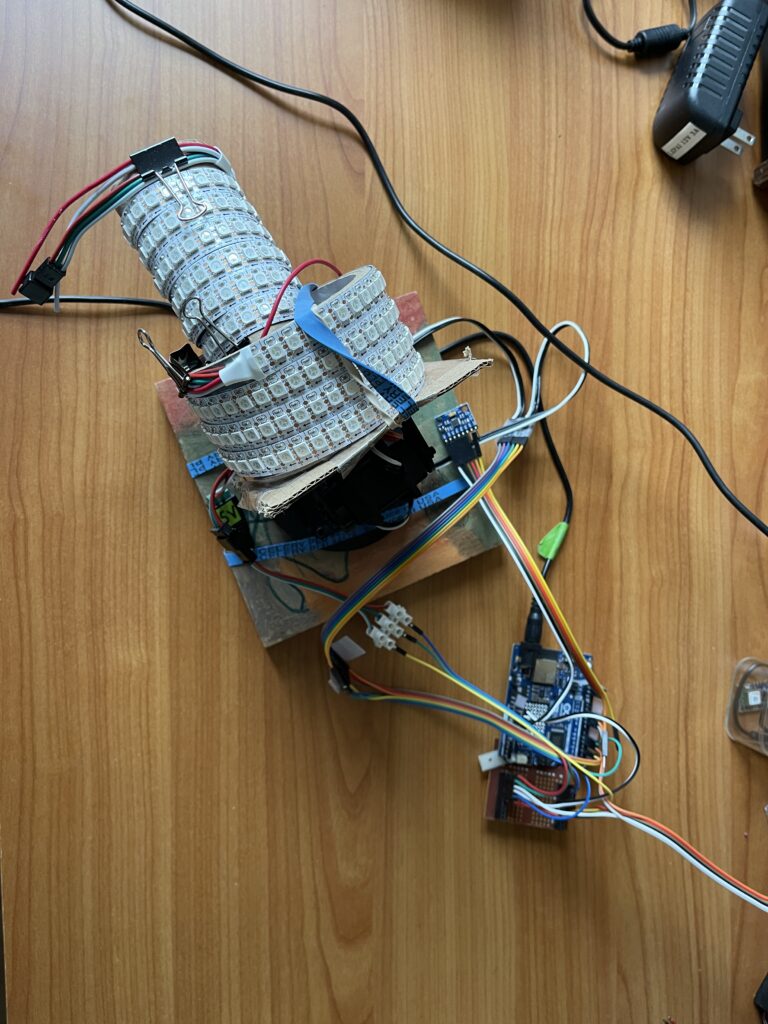
My first use of the LED strips was in an adaptation of an interactive work using iPads. The adaptation used 4 Xbox controllers and the LED strip was a minor visual indicated of the action on each of the controllers, a bit of eye candy at the ACUD Gallery in Berlin in 2022 as part of Unexpected Territiories. This has progressed and the sketches are working towards how to use the LED strips with motion sculpturally, kinetically, spatially. Software in progress will combine the motion of the patterns in the LED’s in counterpoint to the physical motion. One variation is cylindrical. There is an other configuration involving controlled twisting of the strips. These will manifest both as instruments for performance and objects for installation.
There is a common technique in closed loop mechanical control using notched wheels to provide velocity, direction and position. The DC motors are low torque and can be high speed. A feather then a good visual element. The combination of opqueness and transparency offer nice possibilities as recpipeint of light and production of shadow.


A varation to try is control twisting of the led strips under progrmmatic control for correlation of motions, patterns in the LED’s and associated sound.

There are various other curiosities in various states of construction. There are a number of webcams readily at hand from prior projects. Also from prior project I have these relatively high resolution servo motors that can be controlled by the algorithms in MAX that can be correlated with the Jitter computer graphics. To be shown for instance is panning to a computer monitor showing the video feedback and contrapuntal choreography of camera and window (example to be added here).
Of Armatures and Marionettes
One area of development is to choreograph the motion of instrumental loudspeakers and other elements. Here borrowing the idea of control rods from marionettes.
Disco Laser – DMX Control to be supplied
One area of collaboration has been a thread started by John Driscoll who has been focused on repurposing DMX moving head lighting instruments for directional instrumental loudspeakers.
I recently bought a $100 commodity device from Amazon variation that uses DMX controlled laser deflection with DMX control. This is at an intersection the use of vector graphics for visual music and oscillographics as common material in Tom DeWitt Ditto and the David Tudor – Lowell Cross Laser Concerts as points of reference.
I was hoping that there would be an easy way to hack this for the generation of 3d images of our desire using chromadepth glasses that Tom had suggested for Eclipse August 2025 new work for us under title of “Eclipso” (also with Ivars Villum). This doesn’t look practical for this coming August and likely to find other application or more a simple demonstration of the technique. As of May 30th, chroma depth glasses to arrive from Amazon mid-June.
Installation Based on Material from the Mumma Modulator
Pepsi Modulator Revisited – a duet (2021)
A pair of visitor to a gallery are presented a pair of iPads with sliders to adjust a sound field based on material recorded from the “Pepsi Modulator” as recreated by Michael Johnsen from Mumma’s original schematics from 1970.

Pepsi Modulator for 8 thumbs
As possibility is revising this installation work that invites visitors to use XBOX controllers to play variations on recordings made from a recent reconstruction of the Mumma Sound Modulator (by Michael Johnsen) from the E.A.T. Pavilion at the Osaka World’s Fair in 1970. An LED strip (not quite visible here) provides attraction and distraction. A

This is a picture of the reconstruction of the modulator channels used to generate the base audio material for the installation. As configured here, these form a chaotic oscillator, a form of a fractal implemented in physical circuit similar to a Chua Oscillator (link more on this page beow). More can be found under Of and on feedback as structural use of complexity
The device itself does not easily lend itself for interactive use in a gallery setting given the erratic nature of chaotic systems.
As the work on the montage-collage generator has progressed, likely avenue is to use the XBOX controllers as interactive controls for that. This possibly a workable solution for the “nurb” collection.
Eclipse 2024 Sketches
Nurb Wheel Studio Sketches
This is a combination of pretty unrelated threads. I thought the iron wheel would cast nice shadows for a Pulfrich from discussion with Tom Ditto for Eclipse sketches in 2024. I quickly came to the realization that there was no quick and at hand solution to getting this to continuously rotate. Quite unrelated, I had been playing about with a time of computer generated image (NURB) as part of the output of an algorithm that concurrently generated audio as is common in electronic generation of visual music using a technique of vector synthesis as is common to oscillographics and laser deflection light shows.
There are more notes here under cover of Sketches from Eclipse 2024.
Using materials at hand, I decided to use the iron wheel as a resonator driven by transducer from the audio from the random walk generator to animate the nurbs. The yellow clip holds a contact microphone that feeds a loud speaker.
Wheel Nurbs Eclipse 2024
For the gallery, I supplied also a mechanics stethoscope to allow a visitor to hear the sound within the iron wheel without electronics amplification and a set of knobs that allow a visitor to explore and manipulate the parameters of the image and sound generation. The monitor on the left provides visual feedback of the knobs and is somewhat a form of clickbait.
Unabashedly, the intent is that visitor that sits and plays with the knobs or listens on the stethoscope becomes a performer, a character as observed by other visitors.
There are additional video here of sketches of work in progress.
Pulfrich, Spinning Frames, DMX, LED
With realization that the iron wheel would take more time and work, I rummaged around amongst available components and had :
- my childhood erector set,
- hobby servo motors (from the work with Driscoll),
- my obsessive interest in compound pendulums as complex system
- cast off LED’s from John’s de- and reconstruction of DMX moving head instruments
- various single board computers (Arduino’s) and related pulse width modulation drivers for the LED’s
- Tom’s suggestion to use plastic fresnel lenses (typically for aging people to read small print) as collimators
- various tripods
- and some DMX moving head instruments.
By combining various timers and loops, the composite collage takes on a material character largely the product of the software as much as the physical materials.
ISubject to Change

The predecessor to the NURBS was a performance work “Subject to Change” (2022) revisiting the algorithm for Philharmonia here shown with Jakob Edelstein from Berlin and studio snapshot.

With some trepidation, I found and fired up the Max & Jitter patch and did a quick test with Chromadepth glasses that just arrived. Seems like the rings and dot field does produce a depth effect.


Click to see the snapshots of the patch …
Seems like it runs bit better on the M4 as compared to the M1 previously used. Possibly a Mira frame at the top level could yield and an interactive play thing for gallery visitors. Note to self – should make some updated recording with the co-generated audio. The images also need back track to early version.

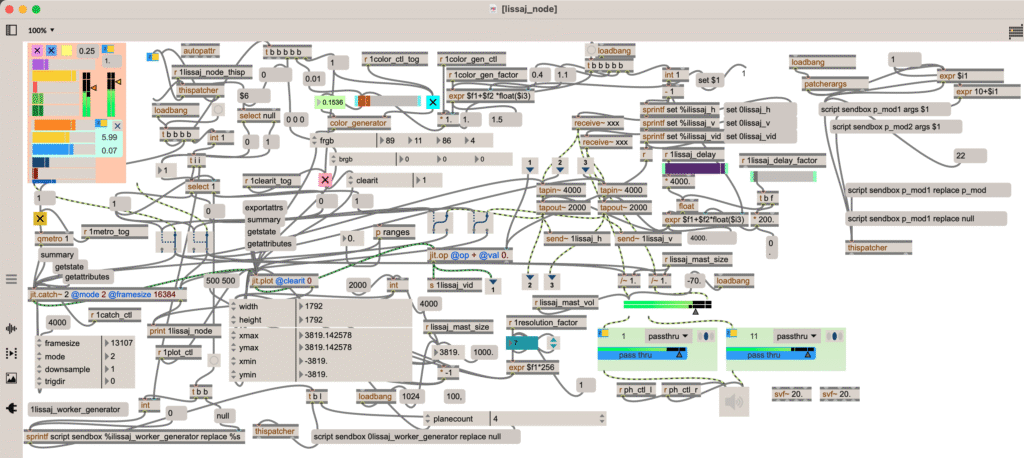
The initial studies were done under cover of Philharmonia Revisited. That post has a collection of videos from the early studies.
An area for exploration is how these can be done in “videoplanes” either by extending the patch or using the extent video as input to the collage-montage generator.
Cluster Field Components
John Driscoll and I in the aftermath of a visit to MAXII in Rome had the seeds for a new installation work that five or so years later surfaces as Cluster Fields. As in all of our collaborative and individual work, there is a constant re-use and recombination of mostly commodity materials as readily found on the internet of our local Lowes and Home Depot. As an aside, this is a progression of using found materials for performances of Rainforest IV going back to 1973.
Here is a brief video of Cluster Fields installed at Zuccaire Gallery at the Staller Center for the Arts from Dec 2024 to Feb 2025.
Globe PVC Transduced with Driver
It is tempting to use one of more of the globe-pvc instruments (shown here floor standing and without horn and transducer. There is a small loudspeaker in what is here the base (and for Cluster Fields, the wall mount).
Fishing Poles, Drain Pipes, Mica Wings, Globe-PVC
Cluster Fields grew out of the idea of clusters build from comodity materials that could architecturaly scale and accomodate a variety of space. The fist two realization consisted of:
- transduced mica “wings”
- drain pipes with small audio drivers
- Transduced globes and PVC audio plumbing with small loudpeaker driver at one end and horn at the other.
Transduced Fishing Poles
John had long been using telescoping fishing poles dating back to the 1980’s on eel fishing on the Spree in Berlin. In the third rendering of Cluster Fields we incorporated 3 of these for our installation at Zuccaire Gallery at Stony Brook (Nov 2024- Feb 2025).
There is a spare fishing pole that may offer to be a convenient sculpturally element for Eclipse August 2025.
Speaking In Tongues Components and Variations, Slight Perturbations and Adaptations

Driscoll has a long history of using a the specific character of demodulation from an ultrasonic feedback loop for performance and installation. These use a combination of purely mechanical means of motion and use of various motors. With his decision to step away from performing, he offered various of his components for such instruments as I had long been interested in developing various software activated and orchestrations.
December 2024, I and 3 colleagues (John DS Adams, Michael Johnsen, join by Gokhan Denec took on a performance of Speaking in Tongues. This possibly the first time the piece was performed without John as a performer. His instructions for the work encourage the performer to develop there own instruments. Here is picture of development of the instruments. There is a single board computer in the pill container with knob that influences the range of rate of the servo motor moving the aluminum foil that acts as a complex mirror to the ultrasonic field from the ultrasonic transducers.
I have been extending the software for the servo motors for the Speaking in Tongues instruments and compnents from John Driscoll.
This is bit of video from an instrument i improvised for SIT from Istanbul. The knob controls overall rate of a random walk rather then simple linear control over rate of rotation. Recent work includes being able to use OSC network protocol to orchestrate over a variety of instruments in an installation rather than performance context. Also considering adding logic that allows visitor control, and when no visitor input, reverts to some automated movement. The ultrasound transducers are more visible in this closeup.
Elements from Istanbul Performances
components include: adaptation of the adaptation of Speaking in Tongues (… add June 2025 ESP Nano, Dynamixel marionette, ….)
Adaptation of the graphics player used for Sophia projections
Calder’s Circus – Whitney November 2024
I finally had a chance to see Calder’s Circus at a visit to the Whitney last year and captured some cell phone video.
Eclipse 2025 Video Player
I developed a MAX Jitter patch intended to show various video clips in randomized juxtaposition with vistor control of which audio to listen to or random walk cross fade if no user input after a minute of so.
List of video to date is here https://composers-inside-electronics.net/cie-wp20/eclipse-2025/#Video_Inventory
Here is a snapshot of the mockup. To be determined if the audio selection via mouse, track ball or iPad.
My thought is to show this on one mid-to-large monitor or projector and setup other monitors with straight sequene of shuffling of the videos.

Eclipse 2025 Web Crawler
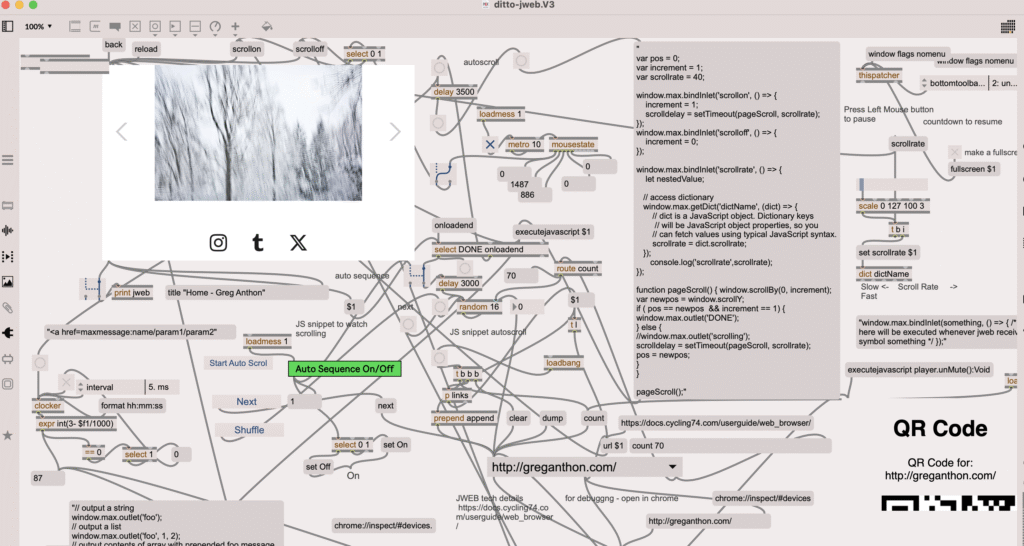
I developed a MAX Patch for Elipse 2025 that takes an embedded list of web sites, displays the page and after a few seconds starts scrolling. A visitor can pause, control scroll speed, or take snap on their smartphone of the QR code for the visited page. The current list includes 3dewitt.com pages, and website of others like Greg Anthon, Stan Van Der Beek, Rudie Berkhout, Ivars Villums, Matthew Schlanger, Benton Bainright (free.art), Paul Friedlander and various other wiki pages (E.g.Pulfrich, Chroma3d). Depending on the availability of equipment, we may do 1, 2 or more “kiosks” or table top with monitor or projector.
List of websites to date is here https://composers-inside-electronics.net/cie-wp20/eclipse-2025/#Links


Chua Graphic – Chaotic Oscillator Video
Chua Circuits are included here as point of reference to the work of Leon Chua. Of note, Tudor, I and other had been long using these techniques and with some bemusement note the wiki pages referencing the “invention” in 1983 long after we had been using this in compostion and performance for the previous decade. The reference also includes a nice found video clip from the internet of a video capture from an oscilloscope. My interest in the structure complex and chaotic system is somewhat of a point of esthetic departure between Tom and I and between John Driscoll and I.
In Philharmonia and other works, Tom’s interest in harmonic systems and relationships is evident.
My interest in the structural and graphical nature of chaotic system was never a notable common ground with Driscoll.
Ogielska Panels – Walkthru Teasing Chaos

Artist Sophia Oglieska and scientist, entrepreneur, sailor Andy Ogielsko produced a work in conjunction with David Tudor in the 1994-1996 that was a large scale visual manifestation of the notations he used in his works Untitled and known also as Tone Burst.
This along with David’s Neural Synthesis were his final works. I was honored to be able to assist with lighting and the installation emphasizing the shadows and 3 dimensional possibilities of the work. This has spawned a slowly developing project for projections as an alternative or extension to the physical panels that was one of the avenues for the recent montage and collage studies and sketches. For Teasing Chaos at MdM Salzburg, one of the images was used as a back drop for the Michael Johnsen’s realization of Tudors’ Untitled. For the performances at Arter in Istanbul in December, i attempted to animate these static images using some of the common techniques familiar back from the work with Tom in the 1970’s with limited success.
Jitter Graphics Player: Montage – Collage Generator
A Jitter Max Patch takes a collection of images and / or video and does a random walk including: fade in/out, super-position with variable transparency, scaling, horizontal and vertical position. Extension also does 3d rotation of the images. (need to add examples).
The choice of MAX Jitter will support further development for sound manipulation and generation.
An Automated Photo Montage-Collage from an Album from My Parents ca. 1944-46
First attempt … refinements below using the montage-collage generator.
In years past, I have scanned a photo album of my father’s photo’s from when he served in the army in the Pacific 1944-5 and including photos of he and my mother when he arrived home soon after Hiroshima and Nakasaki obviated the need for the US invasion of Japan.
These pictures have captivated me as long as I can remember. Now, I’ve taken the photo’s and created a montage using MAX and Jitter using a patch I developed when I delved back into Jitter in a deeper way in steps since 2022 and then in 2024 and now possibly again. These are a remarkable window into a time and place that is captivating personally but I suspect more widely.
To me this is essential digital legacy and remembrance of the best sort if I can overcome the obstacles.
While I am strongly drawn to this, I also have strong doubts on whether this can be refined to a level that I would find satisfying both on emotional and technical level.
I used this patch originally for projecting images from Sophia Ogielska’s Maps and Fragments panels for backdrop of performances of Tudor work in Istanbul Dec 2024. There are deep flaws in the current state in my use of randomness and the rectilinear nature of the motion. The randomness of superpositions is disturbing. There is tension between the content of the images and the mechanics of the algorithm. While the use of randomness is a convenience, it is also a serious flaw here.
The motion control has a number of control parameters. In the first version above, there are setting that result in in jumps in the motion. For now the sample just cycles a few fixed images rather than using the complete album of 26 images included to date. There are additional images to be scanned from the original photos.
My interest is typically combined sound and image and this has me in a very different realm. I don’t have a mental image of what sounds I might consider which is not a particular obstacle at the moment.
I now feel obligated to do further research on exactly when and where the overseas photos were taken. I have memory of my father mentioning Morotai, Philipinnes, perhaps Papua New Guinea (https://www.britannica.com/place/Morotai-island-Indonesia). The US pictures with my mother Atlantic City and /or Brooklyn.
I think that the basic idea is worth for exploring and can see how this may work for other collections of photos and video.
Here is refinement as of May 31 with rapid smoother transitions with a few more images (#3)….
An avenue here is refinement of thematic “cinematic” direction over time.
As of 2025-06-05, an additional set of sketches and Studies here under Montage Collage Sketches and Studies 2025-06-05
Detail here
I forked off new version of the max patch (vid-playerV4) and started generalizing for other image sets. Next step is to work on configuration variables speed, change rates, number of images shown and add evolution over longer time frames. Also in prepartion and adaptation adding interactive controls and live feed for use in performance and installation. This quickly evolved into a refactoring of the code to be described under the above “studies and sketches” page.