
(Private link: Today 2025-05-16)
draft as of May 17, 2025
Many Beginnings
As of May 17, the call for submission for PDMaxCon 2025 https://music.illinois.edu/pd-max-con/ serves as a catalyst that intersected with various other recent threads on avenues of presentation of the interplay of legacy as a necessary seed for inspiration and new works.
I would like to show one or more from a portfolio of MAX patches for interactive installations and or performances emphasizing collaboration and creative evolution and PD/MAX as essential platform and linqua franca in that.
From wikipedia:
“A lingua franca, also known as a bridge language, common language, trade language, auxiliary language, link language or language of wider communication, is a language systematically used to make communication possible between groups of people who do not share a native language or dialect, particularly when it is a third language that is distinct from both of the speakers’ native languages.”
Another catalyst for this is an elegiac survey and remembrances in order of their passing: David Tudor (www.davidtudor.org) (1996), Richard Lainhart (link) (2011), Joel Chadabe (link) (2021), Phill Niblock (2204), Tom(Dewitt) Ditto (2025) that shaped over 50 years of my creative life with due respect to Thorton Wilder’s Our Town and Skin of Our Teeth.
In each of these passages, I have become progressively more aware of the need for celebration of legacy and exploration of archives to inspire and seed new work.
First PD and then mostly MAX has been essential in this.
Proposed here is a survey of works and sketches for possible ICMC 2025, demonstration, workshop, installation and or performance.
Works here might include:
- Shrieks and Nuptials – gen~ and Mira
- Impulsions – fractal control over convolution library and as source
- Pepsi Modulator Revisited & Pepsi Modulator Revisited for 8 Thumbs – Mira, iPad, XBOX controller
- Subject to Change – Jitter visual music integration of generation of image and sound
- Sketches for untitled works in progress – various sensor and sculptural interactive devices
There are others that have contributed and inspired greatly in the passage here especially David Behrman, Laurie Spiegel, Julie Martin that I must mention with gratitude beyond what is acknowledged here in the other various citations.
Profile of the Works
See further details in the Tech Rider
- Shrieks and Nuptials (link): a duet that in the most recent incarnation uses a gen~ chaotic oscillator manipulated via MIRA (or perhaps MiraWeb) combining a simple group of sliders, the accelerometers and / or gyroscopes from the IMU. Requires typically 4 channels of loudspeaker output from generic computer output interface. The work originated on the Coordinated Electronic Music Studio (CEMS) modular Moog at University of Albany in 1975, then ported to a DIY XR-2206 performance device in 1976 for Composers Inside Electronics residency as part of the Paris Festival du Automne, and for the Kitchen for our residency there in 1977. Revisiting a digital implementation in MAX and Mira (2018) for a return engagement at the Kitchen is proposed for consideration for ICMC 2025.
- Impulsions (link) midi control (nominally Novation XL, Akai Mini, Touch OSC, or Morph Sensel) using a library of impulses harvested from the objects as part of the Rainforest IV an V projects and other sources. This can be presented as interactive installation, workshop or performance with one or more performers. There is a point of origin for this from 2011 workshop at Harvestworks from Matt Rogalsky’s presentation then and there. The work is scalable to anything from 4 to as many output channels as available. I would supply either Behringer, Gigaport or Tascam interface(s). For more than 8 channels, preference would be possibly Dante, AES or other IP over ethernet directly from MacOS. The works scale to anything from 4 to as many output channels available. I would supply either Behringer, Gigaport or Tascam interfaces.
- Pepsi Modulator Revisited & 8 thumbs – 1 of two variations (both typically 4 channels)
- The first realization was configured as an interactive duet with a simple MIRA control or playback of recordings from Michael Johnson’s recreation of the Mumma Modulator as part of the E.A.T. Pavilion from 1970 (ca. 2017). This was part of the David Tudor Teasing Chaos exhibition at the MdM in Salzburg (2021) and a recent point of focus coming out of work with the Getty Research Institute for their recent E.A.T. exhibition from the archives there. This was made possible through the support of the Tudor Instrument Collection at Wesleyan.
- The second variation is configured for 4 XBOX controllers and an LED strip to provide a small visual coherence. The second realization was for Unexpected Territories in Berlin (2022)
- Subject to Change – An adaptation in jitter from 2022 for performance or installation that is a remembrance of work with Tom DeWitt Ditto on Philharmonia and Studies for Philharmonia that originated with our work in visual music grounded in vector synthesis from the early 1970 coming out of residencies at the WNET-TV Lab and the Rutt-Etra. The extent version in MAX Jitter was premiered at Unexpected Territories festival in Berlin in 2022 as a duet with my son.
- Sketches for untitled works in progress
- with jitter using interactive manipulation of nurbs and selection of microtonal tunings. The first of the sketched for this shown at the Eclipse Gallery in North Adams MA in 2024
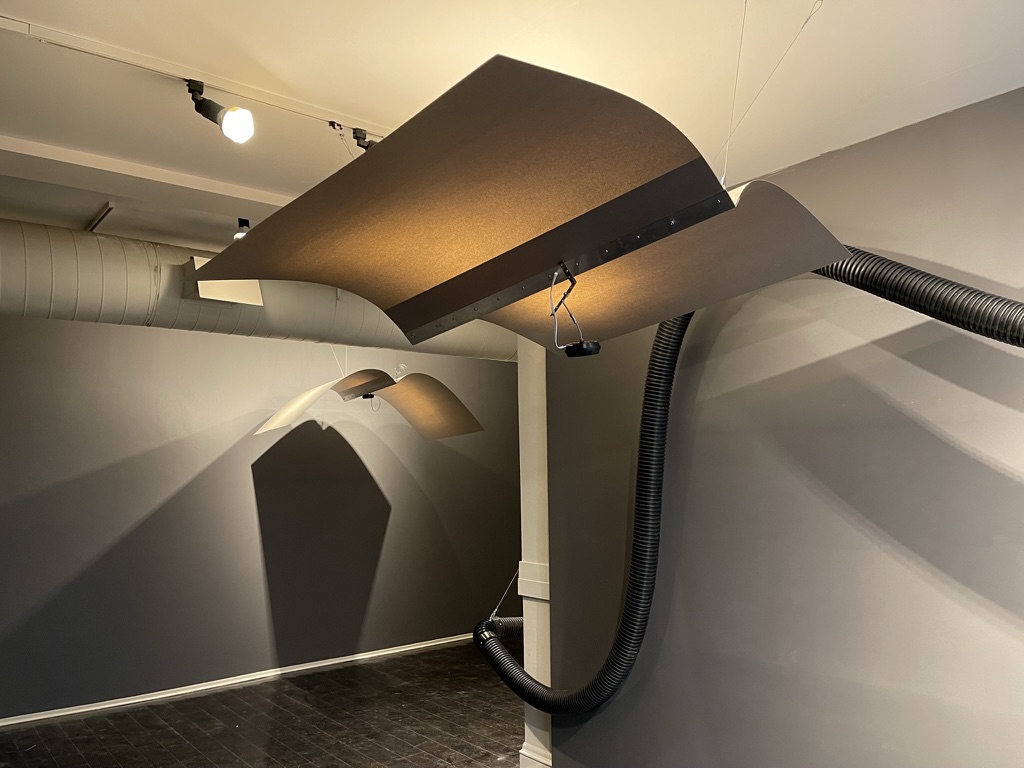
- untitled transduced object and simple closed loop control around the principle resonant node. I would use for this what is likely the metal sheet passed down rom Tudor as used for Bandoneon! (link) for 9 Evenings of Theatre and Engineering (link1, link2, link3) combined with an acoustic talisman from Richard Lainhart from At Once (an eba production) in ~1975 that keeps resurfacing in various forms over the decade.
- adaptation of a John Driscoll’s ultrasonic instruments for orchestration with OSC and closed loop control. As part of the stewardship from John of ephemera from Speaking in Tongues and Slight Perturbations, I would like to show sketches of a method of orchestration of the instruments for self-running and interactive installation using a local wifi and OSC integrating these servo motors devices and more recent adaptation of DMX devices using a small python snippet running on a PiZero as a bridge and armature for the orchestra of a next generation of works.
- integration of commonly available accelerometers, BLE and OSC for kinetic sound sculpture and new interactive instruments.
I am in the process of using sketches from the above for an installation at the Eclipse Mill Gallery in North Adams from Aug 1-31 2025. Given the opportunity to show any for the ICMC in Sept., I would then adapt the sketches to bring from North Adams to Urbana.
More to the Proposal
As circumstances allow, I would be interested as well on surfacing and profiling aspects of use of MAX in several other projects in workshop or demonstration including

- the project LocaleS3 triptych using UWB tracking (origins with the Nousonic tracking headphone and web-based authoring system collaboration with Michelle Jaffe and David Reeder. Includes use of the Qorvo development boards with MAX.
- the use of MAX for Rainforest V variations in the collection of MdM Salzburg, MAC Lyon, MoMA NY and Arter in Istanbul (nominally 2015-2023), and M4L live for Cluster Fields 8-2025)
- use of Ableton Live and Max for Cluster Fields
- sound design for realization of David Tudor’s Weatherings for the Lyon Opera Ballet (2018-19) as well as
- the bloodlines project for the Stephen Petronio Dance Company (2017-19) with encouragement and support from the Cunningham Foundation; Ballet De Lorraine and
- other other Tudor repertory (E.g. Pepscillator, Microphone, Forest Speech);
- use of OpenCV for re-examnation of Pantomation, an early motion capture system and node.js for new work exploring the possibilities with bring-your-own-device for interactive installations and the attendant privacy considerations;
In looking at origins and tendrils of points of departure, I recently found this amongst the archival embers of the internet. Our work on the Design Device was a step leading to the Pantomation motion capture system (Media Studies Buffalo Electornic Arts Conference(1977), Video History Project – Design Device) ) with the realization of how PD/GEMS and MAX/Jitter satisfied the underlying dream and promise for the Design Device.
From a personal perspective, these tendrils have beginnings and cross points with the TEEM system documented on the E.A.T. website https://www.experimentsinartandtechnology.org/ and the emanations from Bell Labs in the mid 60’s.
In tracing this history, I find the coming together at Black Mountain College in the early 1950’s as the indicative inflection point that established creative models what have proved guidance with the availability of electronic technology in the next decades to date.
In Summary
Fundamental aspects I seek to explore in showing any of the works in demonstration, installation, workshop or performance include:
- focused and localized sound and sound as a sculptural medium
- collaboration
- morphing personas: composer, engineer, performer, musician, orchestrator, arranger, audience, viewer, observer, participant
- communion and community
- architecture and nature of electronic and software defined space and places – between the ephemeral and persistent in time based work
- visual music
- utilization of the study of legacy from archival materials for evolution of new work
What is possible here to be shaped by ICMC feedback and practical logistics.
Keywords
MAX, PD, M4L, UWB, Mira, JS, gen~, jitter, nurbs, sound sculpture, architecture, spatial sound, collaboration, improvisation, design, choatic oscillators, IMU, Rainforest V, Rainforest IV, BLE, sensors, Python, Arduino, RPi, DMX, servo motors, laser deflection, vector graphics, feedback (acoustic, electronic, Bayesian, iteration), DSP, generation, processing, interactive, automation, performance, installation, OSC, personas (composer, engineer, performer, musician, orchestrator, arranger, audience, viewer, observer, participant), security, privacy, linqua franca, OpenCV, visual music
How is Max Used
In these works, Max is used as a common language to build systems for performances and installations. These system often involve
- a compositional use of feedback as structural element : electronic and electronic, human-in-the-loop, iteration Bayesian and other),
- real and virtual objects,
- sound spatialization as a sculptural media,
- algorithm – “the process is the product” as attributed to J. Chadabe by T. Ditto
- algorithm as score
- haptics and tactical synthesis,
- interaction,
- graphics,
- automation and automata,
- design and architecture,
- sustainability over long durations as well as immediate improvisational performance
Future considerations involve techniques for orchestration of diverse instruments. The work will grow in utilization of means to articulate gesture across media: visual, acoustic, kinetic for a next generation of collaborative work.
As a point of reference, starting in 2014, MAX was key infrastructure for the Rainforest V edition (variations 1-4) installations. MAX was key to being able to implement a robust self-running system for supporting and integration to the acquisitions at MAC Lyon, MdM Salzburg, MoMA NY and Arter in Istanbul. Each of the 4 variations is of 20 sculptural loudspeakers. Impulses harvested from those objects is incorporated in a variety of other works. There is an ongoing rich tradition of workshops and loans.
The linqua franca of MAX is exploited to connect and network with a wide array of devices and sensors in building diverse systems.
Video and Image Gallery
Shrieks and Nuptials, Kitchen 2018
The audio is from a gen~ single sample feedback loop controlled via wifi connected iPads using combination of the composer/performer selected accelerometer and or gyroscope along with simple performer user interface. The original chaotic oscillator was from a Moog patch on the University of Albany CEMS ca. 1974. With the inspiration of the circuit building workshop at New Music in Hampshire in 1973, I had the motivation to develop as a portable performance instrument in the first realizatoin of the work in 1976 with dancer Marsha Heather Harris. In 2017, the algorithm was digitized using gen~ and the original mechanical interation migrated to the IMU available from MIRA.
Impulsions – Kitchen 2018
This work arose from the availability of convolution reverbs and available to me in PD , then MAX and a practice of harvesting impulses from Rainforest IV and Rainforest V objects. I would like to thank Matt Rogalsky to the workshop presentation in in 2011 at Harvestworks as point of departure for the work. The impulses are used for convolutions and as sources activated through simple fractal generator.
Here is a youtube video of Governors Island offered as part of the tracing of legacy and evolution of Rainforest that contributed to the evolution of the new work.
Nurbs Sketch(es)
Here is one snippet below and link for folder with other examples https://drive.google.com/drive/folders/10oLLa2X2MwcpbMQBvgU3THkJ4u3T7r2U?usp=drive_link
A Jitter nurb generator is used to drive audio patch translating positions to notes. A variation of this allowing user interaction was shown at the Eclipse Gallery in North Adams MA July 2024 using a Midi-twister Fighter controller to manipulate the generator. When there is no user interaction, there is an automated mode that then appears to drive modulation.
These sketches is part of an evolution from physical to virtual objects as avenue and inspiration for new works and such hybrids.
Subject to Change – Villa Elisabeth, Unexpected Territories Berlin 2022
This is revisiting, adapting for performance and digitzing a variation on the algorithm that was used in collaborative works with Tom (DeWitt) Ditto – Philharmonia and Studies for Philharmonia. The original was vector graphics generated on the CEMS Moog at the University of Albany ca. 1974 and processed at the WNET-TV Lab. Here the software realization performed by father and son.

Excerpt from Sketches for New Work
Recent sketches include developing means or orchestrating rotating loudspeakers and ultrasonic instruments developed by John Driscoll as part of our long running collaborations dating back to 1973. Amongst many variations, John had developed a number of individual instruments that used arduino’s and servo motors.
I worked with Driscoll on the control and some of the interfacing with Wii Nunchuks. Dating back to the work on Stall in the 1981, I have long wanted to extend this for closed loop positional control of the sound field and develop means of extended orchestration. This is an example of a being able to form well-tuned counterpoint between physical and virtual rotating sounds adapting the work to site specific characteristics.
Driscoll has provided templates and examples of more recent DMX controlled instrumental loudspeakers repurposing moving head DMX lighting instruments. Work in progress is developing a collaborative vocabulary as an armature and architecture for future work.
Recent development is integrating OSC over wifi using PiZero as bridge betwen MAX and the older arduino controlled legacy servo motor based instruments and newer DMX chains in Python. One avenue for colloabraton is packaging in M4L. These new sketches provide us a means of articulated motion of instrumental loudspeakers and other sonic sculptural objects and clusters of such objects. These new sketches include various means of interactivity including inertial motion units (IMU – accelerometers, gyroscopes, compasses) from discrete components or smart phones and iPads with consideration of browser based access addressing attendant issue of privacy and security associated with bring-you-own-device means of accessing and interacting with creative works. Recent developments expand on the use of QR codes as point of entry.
With the completion of the Rainforest V cycle in the decade of 2014-2024, there has been time and opportunity to revisit and continue studies in the vein of visual music. I suppose in a way that an oscilloscope was one of my first instruments. I have this early museum memory on encountering what must have been Lumia Suite Op. 58 at MoMA as a teenager. Certainly the exposure to graphical score and the computer graphics, vector synthesis, laser deflection systems have indelibly shaped my work. Tom (Dewitt) Ditto introduction to the work of John Whitney Sr. and his own work; David Tudor and Lowell Cross collaborations and Chadabe’s algorithmic composition course reading list including Univerisy of Illinois’ Herbert Brun‘s work. See for additional survey on deflection lasers link and material from Derek Holzer). Of recent note also Jakob Kierkegaard and You Nakai’s Monobirds which delves into a shared piece of my history from a concert and prequel in Albany in 1972 that led to the apocryphal New Music in New Hampshire in 1973. There is another intersection with my first creative experience in lighting design for theatre and dance that I have long wanted to revisit and these sketches for new works a vehicle. One point of inflection came in the lighting and use of shadow possible in the Rainforest V installations. The appearance of shadow as material foretold new work. There lies new challenges between the white gallery walls and the black box theatres we worked in that had possibilities for light as an another essential plastic media for collaboration. The possibilities for virtual objects and ambisonic and other evolving audio techniques to place a virtual sound source projected beyond a gallery wall suggests further means to explore compositional and sculptural spatial sound.
Tech Rider and Further Materials
Note: see in panel below for download and reading options