
Table of Contents
Composed by Phil Edelstein Performers: Meg Schedel, John Driscoll, Tom Hamilton, Phil Edelstein
About the Work and Technique of Usage of Convolutions
There is a technique based on the mathematics of convolutions as adapted to sound which allows the resonant characteristic of and object or space to be applied to a source sound. The analog analogy is the plate or spring reverb as a fixed characteristic. By the 2010’s, realtime software implementations became more widely available for PC’s. Of note, was Matt Rogalsky demonstrating the use of convolutions at a workshop at Harvestworks as part of our Rainforest V project there (ca. 2009? at Governors Island).
In the next years, we (Matt, John Driscoll, I) assembled and extensive library of the sonic “impulse” recordings starting with each of the Rainforest V collections.
With an evolving interest in virtual sound objects and other performance opportunities, around 2015-2017 I worked on the based of the Max patch for variable number of preformers, standard or instrumental loudspeakers.
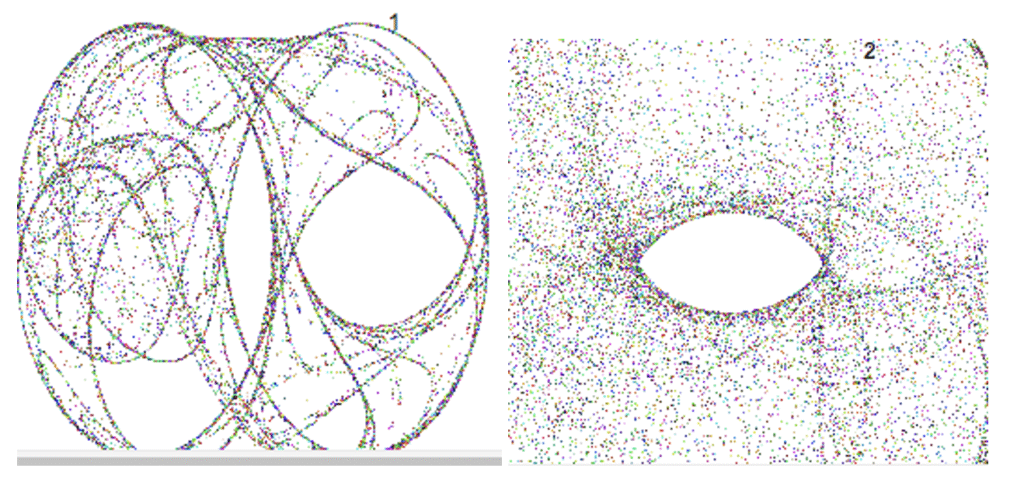
The patch allows a performer to select a set of impulse files and uses the a-clifford fractal generator from the MAX third party Chaos Library fractal generator to use the impulses as both source and resonant filter. For Impulsions, the patterns from the this strange attrator is used to control rhythymand spatial distribution of the sound.
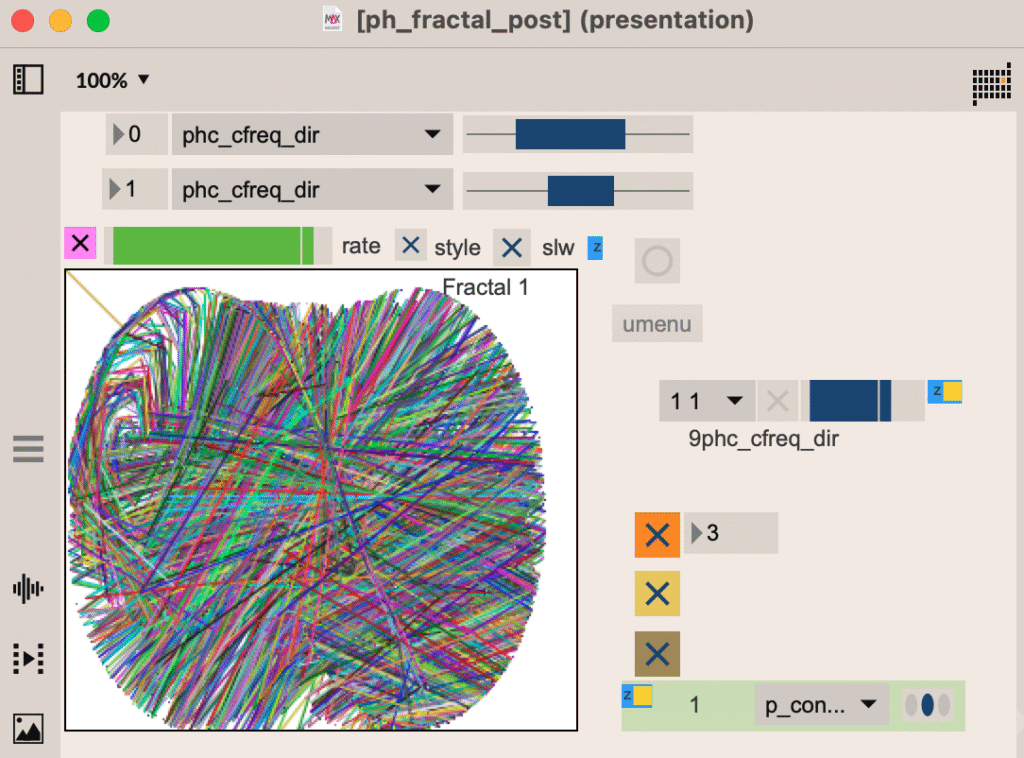
Hidden from view of the performer is the fractal generator embedded in the performer-top level presentation panel.
The work started coming together when I had a quiet evening during the Rainforest IV workshop at Caramoor to try the patch using an array of those instrumental loudspeakers, The work was then performed several times with either standard loudspeakers or once at Broadway 1602 gallery using the Rainforest V (variation 1) objects.
Each performer runs a copy of the patch and the performance is an improvisation based on the constraints of the composition where the algorithm is the score.
The use of convolutions was one of the techniques used in John and I developing the sound libraries for the four fixed variations of Rainforest V. The convolution reverbs served as virtual microphones as an alternative to the contact microphones in the generation of material used for Rainforest IV.
John and I have then used the impulse library and convolution reverbs in various other work such as Cluster Fields.
As an aside, see also CIE at MoMA in 2019 performance of David Tudor’s Forest Speech.
Future Usage
Of interest is adapting this for use in an interactive installation possibly as one of the elements was a consideration for Eclipse August 2025 or other projects.
Variations include providing visitor with a appropriate control surface to to influence the automations inherent in the work.
Click here for notes on computer hardware and operating system considerations
The orignal a-clifford fractal generator MAX third party plugin was not been ported from Apple’s Intel architecture to the new Apple Silicon. Recent work in June 2025 indicates that the Apple Silicon with running Max in Rosetta emulation will may allow on going use on the new Apple hardware. Other possibility is running Max under Windows.
As of March 2026, I was able to create a replacement version of the long deprecated object in javascript for MAX and have the patch now working again. Chatgpt was a help in making the math clear for that.
The Impulse User Interface (imp_ui) Max Patch
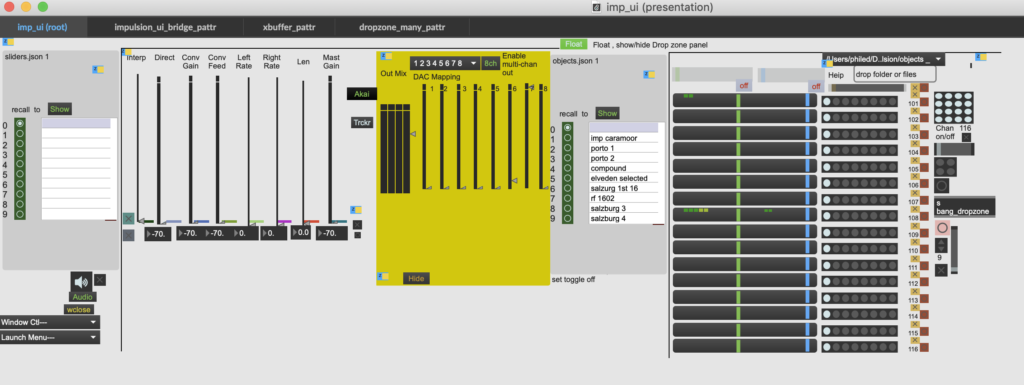
[…] brought forward to Apple Silicon. I used the a-clifford object in several large patches including Impulsions. Here I was able to get this running again by running Max in Rosetta (a flag found in the MacOS […]