
Here is a sample of the stc-masterV1.maxpat image and details of configurations and features from latest work.
Table of Contents
Preface
This is a combination of a guide to the process of developing an installation version of the work and technical study in latest developments of Subject to Change as of June 2022. Aspects of this are combination of musical score, documentation, journal, software engineering details and specifications regarding the work.
This serves as a parable of the nature, ephemeral character and fragility of digital works and the level of detail and understanding required for the realization of this work.
This surfaces some of the original algorithms as Tom Ditto (DeWitt) described in our discussions about the work. There is also underlying pentatonic tuning that surfaces in various of the quantizations and controls.
Click here for more details on Tom’s idea for works for chroma depth glasses and tie-in to the landmark 1919 solar eclipse to test Einsteins theory of general relativity (Britannica article link). Tom was thinking about ways of riffing on the Eclipse idea for use of Chroma Depth glasses for a 3d visualization eclipse like occlusion (using a CO2 fileld weather balloon also to be used as an acoustic lens for a sound field i would devise.
In February 1919 two teams of astronomers from the Greenwich and Cambridge observatories set out for Sobral, Brazil, and Príncipe (an island off the coast of Africa), respectively, with sophisticated equipment that would allow them to photograph a solar eclipse as it cut across South America, the Atlantic Ocean, and Africa on May 29. The purpose of the expeditions, arranged by Frank Dyson of the Royal Greenwich Observatory and Arthur Eddington of Cambridge University, was to test Albert Einstein’s theory of general relativity, which had been published in 1915 and was still regarded with skepticism by many scientists.
A recent area of work has been adding a new output view that adds cross fade, and rotations arranging the concentric motif from the 2022 version.
The technical notes here includes delving into a feature that was deprecated on Apple Silicon and here resurfacing using the Apple “Rosetta” emulator for a fractal generator that is native for latest Apple hardware.
Background
As noted under separate cover, this is a re-visiting of Philharmonia and Studies from Philharmonia from 197? with Tom Ditto.
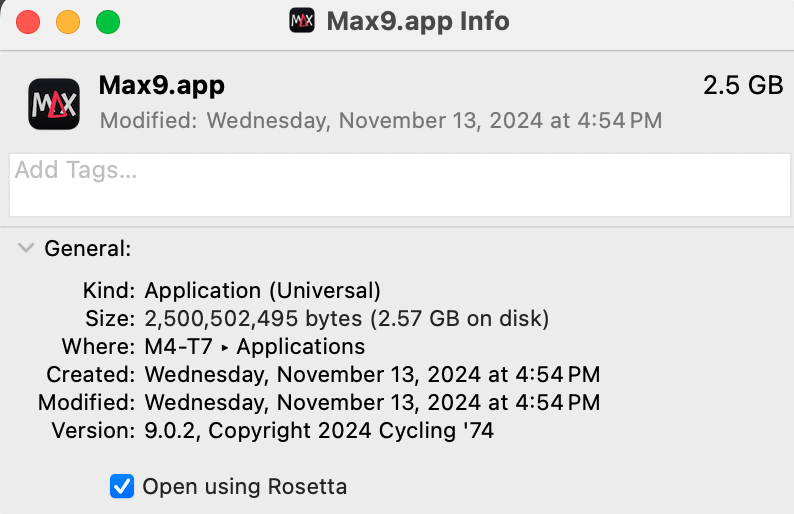
There are some Max Jitter patches more or less going back to 2017 from running on Intel architecture using the a-clifford fractal generator form the A-Chaos library. This thrid party “external” has not been brought forward to Apple Silicon. I used the a-clifford object in several large patches including Impulsions. Here I was able to get this running again by running Max in Rosetta (a flag found in the MacOS info panel) and will support also work in an installation version based on that work.
Basic Operation of the Philharmonia-Revisited and Subject to Change Sound and Image Generation
The work starts with the idea of a lissajous circle – a basic piece of trigonometry with x = sin(t+p) and y = cos(t+p) where “t” is a time variable signal that can also exist as a sound. The circle is in variant over frequency but flattens to a line by change the phase “p”. The size of the circle is managed by multiplying by “size” … x=size * sin(t+p) and y= size * cos(t+p). There are then various modification layered that modify the image in various ways. There are then additional modifications under various forms of manual and automated controls.
A sequence of (here) up to 6 copies are generated that in early version form in general on top of each other. In the June 2022 variations, each of the 6 is place in a circular pattern. The 2025 enhancement as described below off additional modulations and views with a starting motif of 6 rings around a circle.
The Patches
There is a common myth in software development of self-documenting code that I once held as an noble aspiration. Over time, I have relied more and more and more and more annotation and notation. I have come to the point that these diagrams make sense for a few hours and than a day later required much re-examination.
Over long period of times, and as essential upgraddes to operating systems and the required software changes, there can be a fair amount of work to insure that the work operates as originally “intended” or at least as it originally worked (warts and all).
I show here for myself and anyone who might be interested snapshots of the software programs implemented in the MAX patch language. This has two view: a presentation view with is a “user interface” or performer view; and a editting view show the connections between the boxes that form the program.
Upon recent examination, in moving across folders, all required objects were collected into a new folder in a Dropbox folders with absolute addresses to location of the Dropbox with the principle files as below.
Ideally, the work is viewed as live real-time generation of sound and image. These are from time to time recorded as video.
Top Level – subject-to-changeV3
This is the top level presentation of the control panel of the subject-to-changeV3 MAX patch. The colored rectangles and buttons are various controls that allow modifications to parameters for the sound and image generation. For performance, these are connected to various controllers and can similarly be adapted for interactive viistors to an installation.

Click for working list of file
This folder contains current and some early files as helpful in understanding progression of the work.
/Volumes/EXT4TBA/Dropbox/SUBJECT TO CHANGE/PHILHARMONIA_REVISITED
- color_generator.maxpat
- cscale_sender.maxpat
- cscale.maxpat
- diagnostics.maxpat
- lissaj_node.maxpat
- lissaj_obj.maxpat
- lissaj_worker.maxpat
- motion_control.maxpat
- myplot.maxpat
- null.maxpat
- ph_audio_mix_many.maxpat
- ph_audio_mix.maxpat
- ph_ctl_factory.maxpat
- ph_ctl_ipad.maxpat
- ph_ctl_many.maxpat
- ph_ctl.maxpat
- ph_fractal_post_many.maxpat
- ph_fractal_post.maxpat
- ph_revisited_node_test_generic_patch_state.json
- ph_revisited_node_test_pattr.maxpat
- ph_revisited_node_test.maxpat
- ph_revisited.maxpat
- probe.maxpat
- replace_script.maxpat
- stc_gain_ctrl.maxpat
- stc-vidplane-masterV1.maxpat
- stc-vidplane-workerrV1.maxpat
- stc-vidplaneV1.maxpat
- subject_to_change.maxpat
- subject_to_changeV2.maxpat
- subject_to_changeV3.maxpat
- test_lissaj.maxpat
- tune.maxpat
- Xph_fractal_post.maxpat
For performance of Subject to Change in Berlin 2022, a “gain-ctl” capability was added using MAX Mira to allow performer to control from an iPad audio output from each of the 6 generators into a multi-channel sound system. Configuration here does speaker assigns for spatialization for 24 channels from each of two channels from each image and sound generator.

Fractal Positioning – ph-fractal_pos object
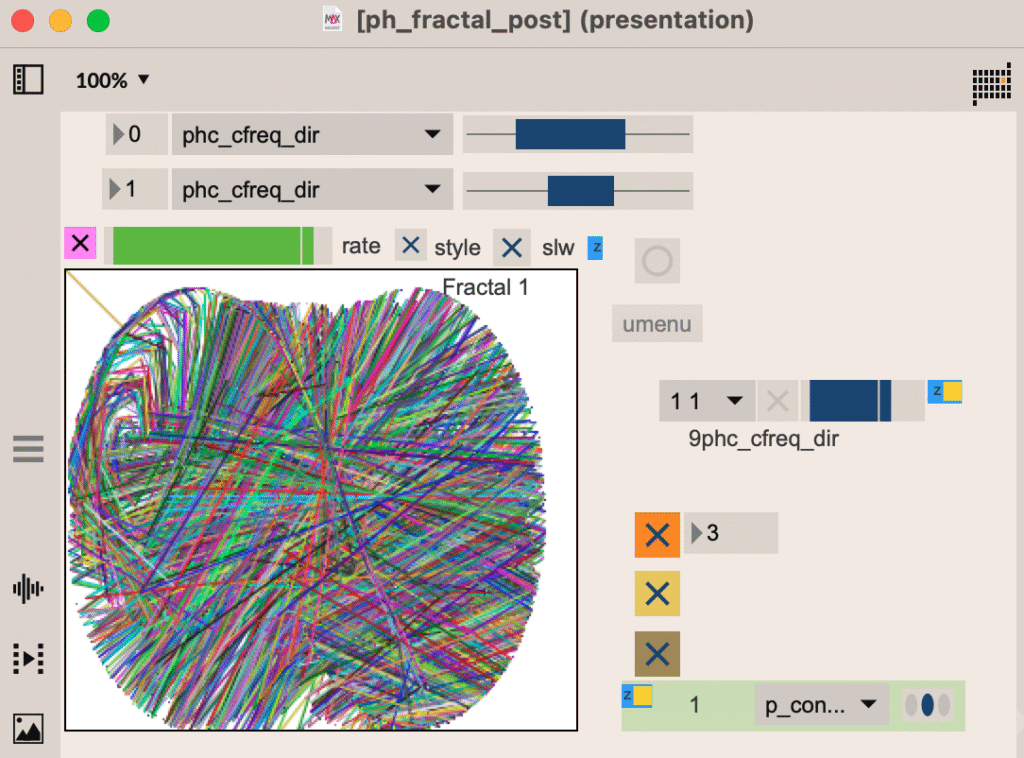
Deeply buried in the patch is a the use of the a-clifford fractal generator. This generates a graph example shown from a “presentation” view from the perspective of the developer.
Digging deeper, the ‘edit’ view shows the wiring. In the center is the “a-clifford” generator that runs in Rosetta mode on Apple Silicon. (while the sources are available on git hub, to date, these don’t seem to compile on the Apple silicon… https://github.com/njazz/a-chaos-64. See also Cycling 74 forum.

stc-vidplane-masterV1
This module as added to genearate (using the poly~ multi-voice object) and to manage each of the image “workers” in stc-vidplane-workerV1. An initial set of controls and automation is provided for : scale, rotation, size, overall fade.

stc-vid-plane-workerV1
The primary function of this module is to add additional control for each of the 6 images as output into the stc_masterV1.
The Jitter chroma key object is used to remove the black background from the “jplot” lissajous generators and allow composing together using the extensive controls in the jitter videoplane object.

Additional Considerations
Convolution Reverb and other Audio Modulations

There is a module from prior work that allows addition of for instance a convolution reverb into the audio path.
There are some adjustments needed to accomodate the location of the impulse files from old machine hardcoded absolute path to latest implementation.
Interactive Installation
For Eclipse 2025, this work can be packaged for visitor interaction.