
Table of Contents
Overview
Convolution App grew out of a the basic idea of an audio sample modified by a convolution revert. We used Gemini and Clause AI tools to generate a web audio app that runs in a browser. This was used to produce an 8 channel work sample.
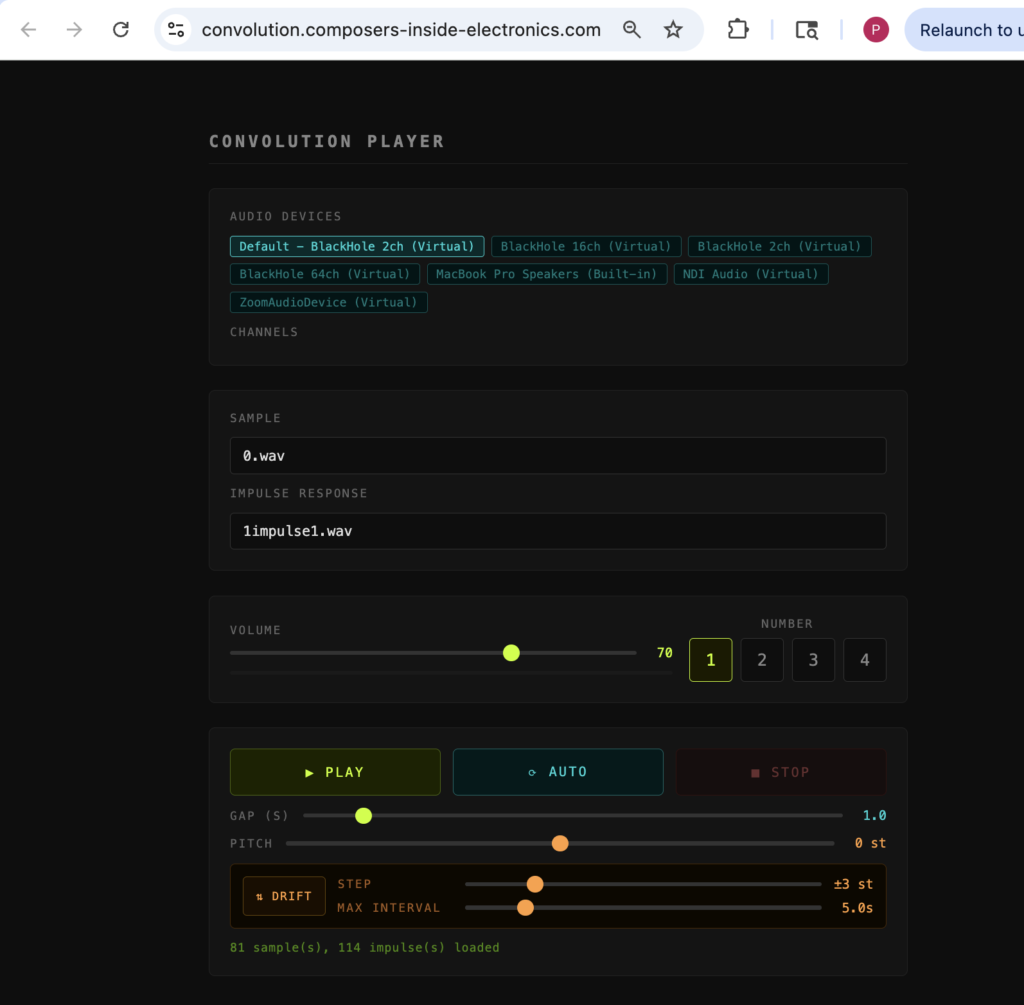
Here is link to a single channel audible on most any browser https://convolution.composers-inside-electronics.com
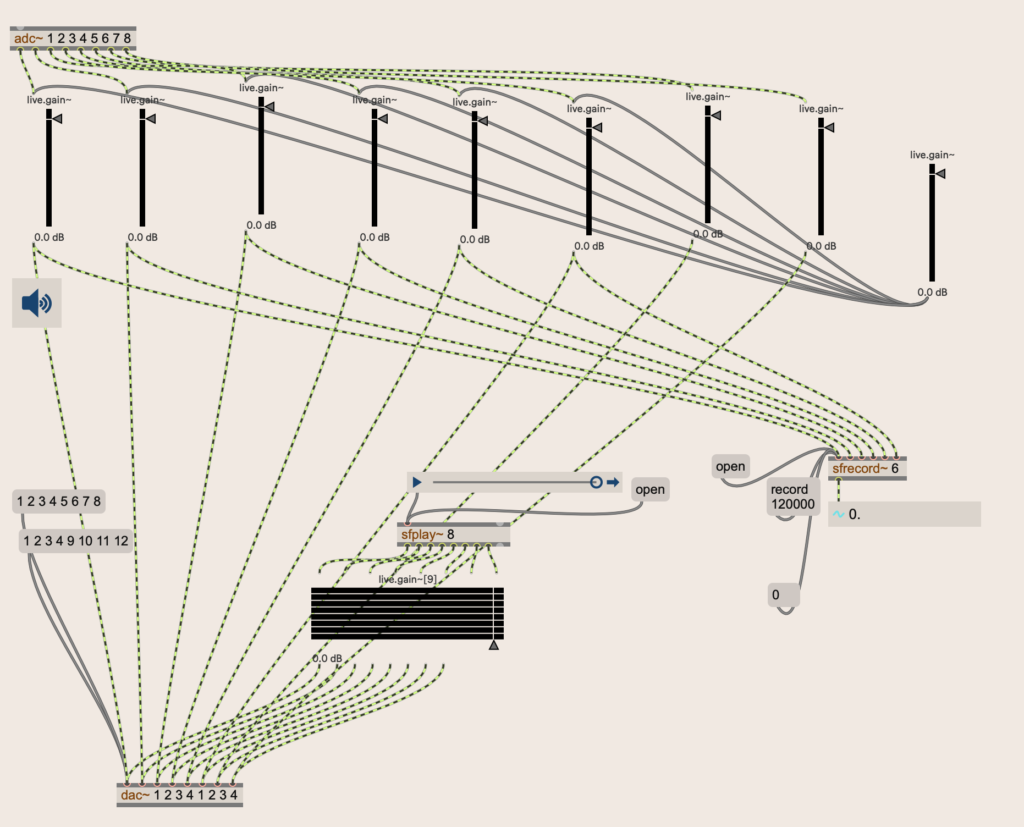
The work sample was producted using tmultiple bowser instances routed to Blackhole. A simple MAX patch then was used to record 2 minutes of multichannel audio.
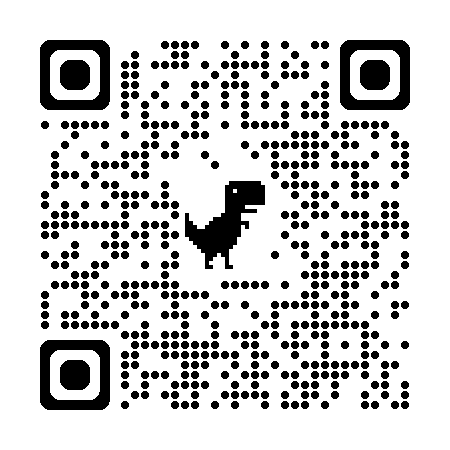
For New Ear we would play either a 1 hour recording or run a live generation of the multicchennel mix on a mac mni Additionally we would provide a QR code and invite listeners to play the app live on their smart phones as they valk around the space.
QR Code
Screen Snap Shot
GITHUB Link
- https://github.com/jake-edel/convolution-player – readme (MD) is a bit stale
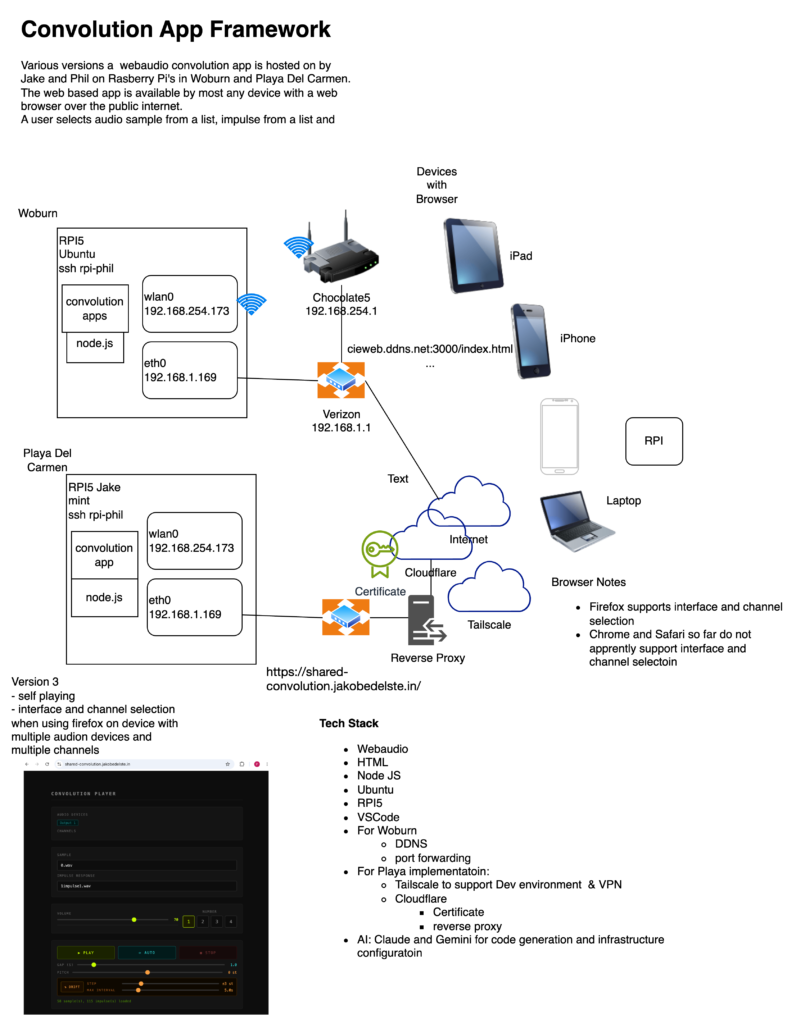
Context Diagram as of June 19, 2026
New version to be supplied with latest updates with https://convolution.composers-inside-electronics.com running on the Woburn RPI5. (some minor correction)
MAX Patch
(two runs of 6 channels each were editted together 6+2 to create the 8 channel sample)
Background
History
This grew out of the work from the Composers Inside Electronics Rainforest project. In 1969, David Tudor was commissioned by Merce Cunningham for a work Rainforest that used signals sent to transducer attached to small resonant objects amplified with contact microphones. I 1973, at New Mucis in New Hampshire, Tudor conducted a workshop that was the genesis of Rainforest IV performed installation and Composers Inside Electronics.
With the advent of software based convolution reverbs in the 2000’s (e.g. HISS, MAX, Ableton), opened up variuous possibilities for an idea of virtual objects.
With the recent availability of AI code generation in tools such as Gemini and Claude, the effort to generate web audio apps has been greatly reduced.
Recent Developement
For Convolution App, we seek to explore new landscapes. This is the first of a series of work that used the tech stack here for various applications.
One of the notable characteristics is software application infrastructure that uses certificate from free tier of Cloudfare here used to provide a secure public access. The use of a fully qualified certificate (rather than self-signed) and surfacing the underlying app on the public internet.
This opens the way for future use of smartphones as ready interactive devices to support visistor s to influence installations. In addition to the basic access to the device and channel selection, this opens the way for use of smartphone’s gyroscope, accelerometer and magnetometer (compass) .
An early iteration genertated wth Gemini forward OSC message based on the user selections which was proof of concept to demonstrate how the framework could be used for users to interact with the live audio environment.
We envision for instance, integratng a variation of this app for influence the audio and motion of rotating loudspeakers following designs by John Driscoll as implementat in John and Cecilias Gestures and Murmurations.
The technology framework exposting a web based application for visitor bring your own device interactin here has underlying implications and exposes challenges. While this work could have been done through old style manual coding, the AI tools is transformational in this rapidly evolving landscape. We also give due considertion to the privacy and trust concerns iinviting and expecting visitor participants to use their own devices as part of edperiencingt he work. To democratise and deal with the step to that trust, in an installtion environment, we would likely supply various artist supplied devices to allow visitors who may not be comfortabe or trust artist supplied application on there device.
Ongoing Development and Future Directions
Additional Source Material
As of June 20226, an initial set of source materials and impulses are provided. Additional materials to be provided either under separate URL or via user selection of folders.
One are of exploration is to add spatialization between stereo pair within the browser of more extensively in the live mutli-channel mix.
User Interactions – Various Configurations and Opportunities
The technology framework here support opportunties such as:
- The simple availabilty of listing on your own device then encourage the proliferation of point sources.
- Future version of interest is to use the visitor interaction to modulate not only the audio from their devices but
- in the fixed loudspeaker in the room
- affect the available samples and impulses
- Future version of interest is to use the visitor interaction to modulate not only the audio from their devices but
- multiple user interaction: e.g. modulations based on visitor orientation. A modulation might be using the compass to inputs across multiple uses so that a particualar sound characteristic would be revealed by multiple participants facing the same direction.
Notes on Source Material as of June 2026
The impulses in the inial version were plucked from an extensive impulse library collected from Rainforest objects and other source.
These sound samples were pulled from Edelstein’s library of audio various sketches and projects. For inscane:
- Sonification project from around 2012 of :
- seismographic feeds over the pulic internet
- Historical Federal Reserve Bank interest rates
- use of fractals for structuring generative MAX and PD patches
- use of impulses
- realizations of various techniques used for CIE and personal projects
We are likely to further refine the sample and impulse library.
We also would like to consider supporting audio materials (sample, impulses) to be uploaded by other contributors.