
work in progress
Table of Contents
Purpose
The is intended to identify common terms and context for various works and techniques categorizing differences and hybridization combining degree of central vs. distributed architecture. Implications to composition, installations, performance and spatial sound.
This is intended as an aid to the nature of creative systems and CIE works which combine both centralized and distributed aspects.
Points of reference include:
- classical sound re-inforcement which tends to central control.
- Most pre-1950’s classical western orchestras are centralized.
- Individual performers tend to centralized paradigms.
- “Folk” music verbal traditions tend to distributed.
- Centralization tends to control and authoritarianism though can be essential to individual expression.
- Distributed model tend to be more influence organized.
- Self-organizing systems often have an underlying algorithm that define the behavior of the elements of the system
Introduction
Collecting here various thoughts and material regarding technical architecture for installations and performance.
Considerations include :
- Centralized vs. Distributed terms of reference and concepts
- degree of connectivity
- hierarchical and non-hierarchical
- self-organizing systems
- central authoritative
- independence of action
- collaboration
- improvisation
- open vs. closed system
- feedback
- Background
Centralized vs. Distributed
I survey here thoughts on distributed vs. centralized architecture for perforance and installations.
Background and Scope
Noting here various project and pieces and where they exist on the spectrum between Centralized and Distributed.
Rotating Loudspeakers
To date, many of the rotating loudspeaker works have tened to be centralized (e.g. Stall, Gestures and Murmurations) have tended towards centralized models.
Future works may explore more distriburted models and principles of self-organizing systems that rely on modulatirized components interacting by influence rather that explicit control .
Rainforest IV
The early realization for Rainforest IV by CIE were largely de-centralized. Each participant would prepare their own objects and source material. Depending upon the venue, there was variation in the amplification and loudspeakers. Often fixed loudspeakers were share often base don proxmity to the individual performers.
In some later realization of Rainforest IV under Matt Rogalsky’s leadership, de-entralized performance was recorded and then played back centrally.

Rainforest V
Rainforest V variations 1-4 use a central Mac Mini that has a library of sounds for each object for each variation.
Cluster Fields
To date, Cluster Fields realizations use a central point of signal generation to drive a distributed network of sound emitting objects. The point of signal production is an Ableton set with structure mutually agreed and separate elements provided individuatlly.
Gestures and Murmurations
… to be supplied …
Interfeed (Driscoll, Edelstein ~1974)
As originally conceived by Drisoll and Edelstein arround 1974, two performers produce signal and send and receive signals from each other.
Pepscillator (D. Tudor ca. 1970)
Pepscillator as orignally conceived used centralized signal generation and distributed audio output.i
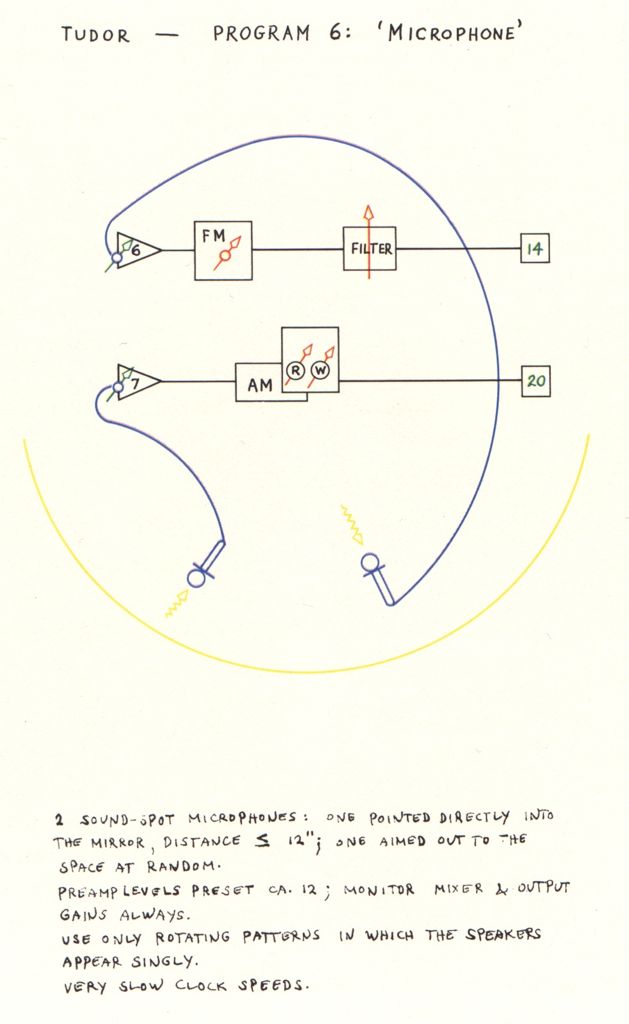
Microphone
The sound generation for Microphone is centralized for performance with distibuted dissemination
Shared Convolutions
Prototype App
The prototype app has a central algorithm that is realized by independent actors with smartphones
Proposed Installation
A realization of the Shared Convolution app as an installation is envisioned where the visitors influence an array of sonic elements
Keywords and Concept
network, reticulated, authoritarian, control, influence, self-organizing sytesms, feedback, diversity, hybrids, environmental constraints, Modularity, Ableton, Max, Max for Live, Raspberry pi (RPI, PiZero), Arduino, DMX